

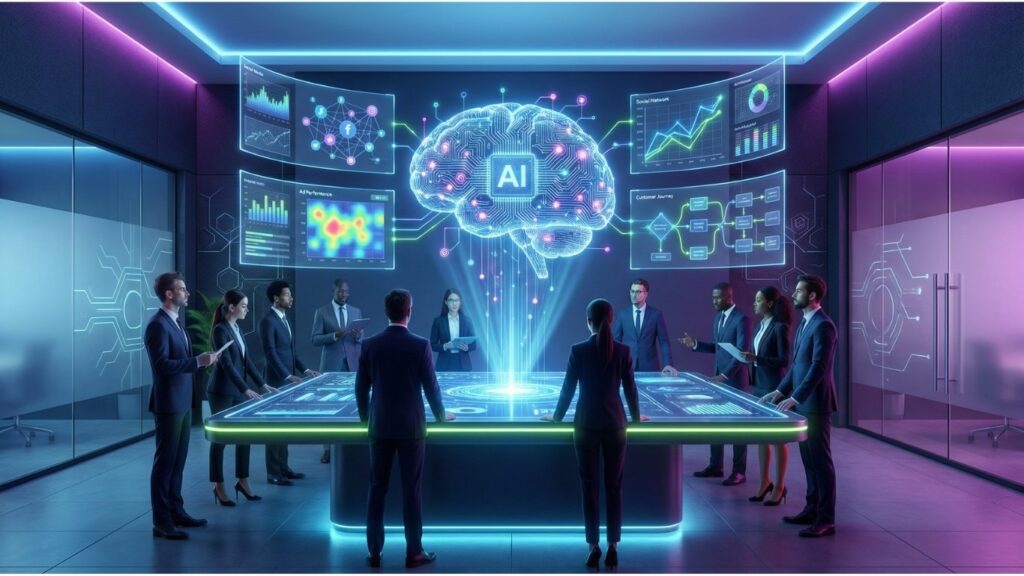
The digital landscape is shifting beneath our feet. As we move deeper into 2025, the conversation is no longer about if you should use artificial intelligence, but how deeply it is embedded in your strategy.
At our agency, we’ve seen this shift firsthand. In just the last 12 months, the client questions have moved from “Can AI write this blog?” to “How can AI build a predictive revenue model for us?”
For agency owners, marketers, and business leaders, understanding the role of AI in digital marketing is now the difference between leading the pack and playing catch-up. This isn’t just about faster copywriting; it is a fundamental restructuring of how brands connect with humans.
Below, we explore the seismic shifts AI is bringing to the industry, answer your most burning questions, and provide a roadmap for navigating this “agentic” era of marketing.
The New Reality: How is AI Changing Digital Marketing in 2025?
In 2025, we are witnessing the rise of “Agentic AI”—autonomous systems that don’t just wait for a prompt but proactively execute complex workflows. The role of AI in digital marketing has evolved from a passive assistant to an active engine of growth.
The biggest shift is the move from “segmentation” to “hyper-personalization.”
In the past, we grouped audiences by age or location. Today, AI-driven digital marketing analyzes thousands of data points—from dwell time on a specific webpage to sentiment analysis of a customer’s support ticket—to predict exactly what that individual needs right now.
Industry Insight: A recent McKinsey & Company report highlighted that personalized marketing can reduce customer acquisition costs by up to 50%. We’ve seen this in our own data: when we switched a recent B2B client from generic newsletters to AI-segmented content streams, their open rates didn’t just inch up—they doubled.
This shift impacts every layer of the funnel. Top-of-funnel awareness is now driven by predictive algorithms that serve ads to users before they even search for a solution.
The Toolkit: Which AI Tool is Best for Digital Marketing?
A common question we hear is, “Which tool is the best?” The honest answer is that there is no single “magic wand.” The “best” tool depends entirely on the specific function you need to fulfill.
To build a robust use of AI in digital marketing, you need a stack, not a single tool. Here is the breakdown of the top contenders we rely on in 2025:
1. For Content & Copywriting: Jasper & ChatGPT (Team Plan)
While ChatGPT remains the best generalist, Jasper has carved out a niche for enterprise marketers. We use Jasper to upload our clients’ specific “Brand Voice” guidelines, ensuring that every piece of content sounds exactly like them, not like a robot.
2. For Visuals & Creative: Midjourney & Adobe Firefly
AI in digital advertising relies heavily on stopping the scroll. Midjourney continues to produce the most artistic, high-fidelity images. However, for our corporate clients concerned with copyright, we stick to Adobe Firefly, which is trained on safe, licensed stock imagery.
3. For SEO & Strategy: Surfer SEO & Perplexity
Surfer SEO analyzes top-ranking pages and tells you exactly which keywords you need to compete. Perplexity has become essential for our research phase; it acts as an answer engine, helping us find citations and data points faster than traditional Google searches.
4. For Data & Analytics: HubSpot AI & Google Analytics 4 (GA4)
Data is where the true power lies. We recently used GA4’s AI anomaly detection to spot a broken checkout link on a client’s site within hours—a catch that saved them thousands in lost weekend revenue.
The “Job” Question: Is AI Taking Over Digital Marketing Jobs?
This is the elephant in the room. If AI can write, design, and analyze, what is left for humans?
The data suggests a shift, not an extinction. AI is not taking over digital marketing jobs; it is elevating them.
According to Gartner, by 2026, organizations that adopt AI transparency and trust will see a 50% reduction in risk. This signals that the human element—oversight and ethics—is becoming more valuable, not less.
Routine tasks like manual bidding in ad auctions or resizing images have been automated. However, this has created a massive demand for AI Strategists. The value of a marketer today is not in their ability to write a blog post, but in their ability to direct the AI to write a brilliant one, and then verify its accuracy.
Think of it this way: AI is the engine, but the marketer is the pilot. We tell our junior staff constantly: The marketers who will be replaced are only those who refuse to learn how to fly the plane.
Real-World Success: What is the Best Example of AI in Marketing?
To understand the use of AI in digital marketing, we must look at who is doing it right.
The Global Giant: Coca-Cola
The “Create Real Magic” Campaign invited digital artists to use GPT-4 and DALL-E to create artwork using iconic Coca-Cola assets. It worked because it combined community engagement (UGC) with brand safety, generating thousands of pieces of free, high-quality content.
The Personal Touch: Spotify
Spotify’s “DJ” feature uses OpenAI to create a personalized, realistic voice that introduces songs. It turns a standard utility into a hyper-personalized relationship.
The B2B Growth Engine: Drift (Mini Case Study)
It’s not just for big consumer brands. Drift, a conversational marketing platform, utilized AI chatbots on their own site to process pricing inquiries.
- The Strategy: Instead of forcing users to fill out a “Contact Us” form and wait 24 hours, the AI bot qualified the lead instantly based on company size and budget.
- The Result: They saw a drastic increase in “pipeline velocity”—deals closed faster because the AI handled the administrative friction, letting the sales team focus solely on interested buyers.
Core Applications: How is AI Used in Digital Marketing?
If you are looking to implement AI in your agency or business, focus on these three core pillars:
1. Predictive Analytics & Forecasting
Stop guessing your budget. We use AI tools to analyze historical sales data to predict exactly when seasonal spikes will hit. This allows us to allocate ad spend more efficiently, moving marketing from “reactive” to “proactive.”
2. Chatbots & Conversational Marketing
Modern chatbots don’t just follow a script. Powered by Natural Language Processing (NLP), they understand context and sarcasm. They can qualify leads 24/7.
3. Dynamic Content Optimization
In AI in digital advertising, static ads are dying. AI systems can now test 50 variations of a Facebook ad headline simultaneously. We recently ran a campaign where the AI auto-rotated headlines every hour, resulting in a 20% lower Cost Per Click (CPC) compared to our manual A/B tests.
Conclusion: The Trust Factor (E-E-A-T)
As we embrace these tools, we must remember Google’s E-E-A-T principles (Experience, Expertise, Authoritativeness, Trustworthiness).
The web is being flooded with mediocre, AI-generated content. To stand out, your brand must double down on Experience and Trust. AI can give you facts, but it cannot give you wisdom. It can write a case study, but it cannot replicate the genuine human emotion of a client testimonial video.
The winning strategy for 2025 is a “Cyborg” approach: Use AI for the heavy lifting of data analysis and drafting, but inject heavy doses of human oversight and personal storytelling into the final output.
The role of AI in digital marketing is to handle the robot work so that you can focus on the human work: building relationships, storytelling, and strategic thinking.